
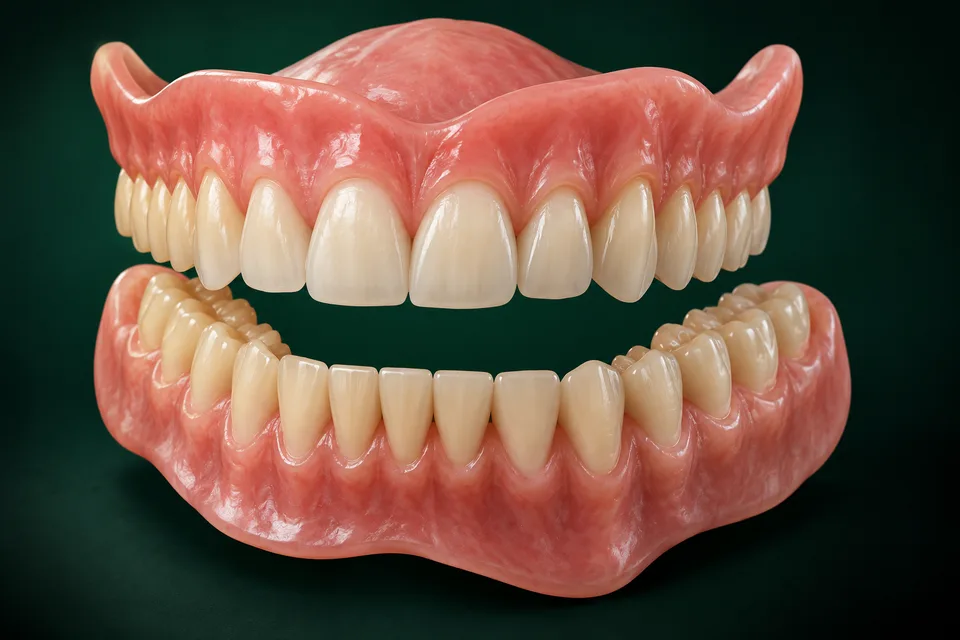
Complete denture
Denture teeth
Replacement teeth set in the base.
Acrylic or composite teeth are arranged for your bite, face and speech. Shade, shape and position are planned with you; they are the only part most people see.
Restore confidence & function · Eagle River, AK
Explore how dentures are built and how they stay in place, in cross-section. Compare complete, partial and implant-retained designs, lift each one off the ridge to see its fit surface, and learn what daily care looks like for every design.
Signature experience The Denture Studio
A complete denture replaces every tooth in an arch and rests on the gum ridge. Select a part, or lift the denture to see its fit surface.
Select a part
Complete denture
Replacement teeth set in the base.
Acrylic or composite teeth are arranged for your bite, face and speech. Shade, shape and position are planned with you; they are the only part most people see.
Complete denture
The pink acrylic that carries the teeth.
The base spreads chewing force over the ridge and gives the cheeks and lips support. Its shape follows your ridge; an upper complete denture also covers the palate.
Complete denture
The inside, moulded to your gum.
The fit surface is a negative of your ridge. A complete denture is held by suction and the close fit of this surface, which is why the ridge changes over time affect how it stays in place.
Complete denture
Gum over the bone that remains after tooth loss.
The denture rests on the gum, not on the bone directly. Sore spots form where the base presses unevenly, so adjustments are part of normal care.
Complete denture
The ridge slowly remodels without roots.
Bone needs stimulation from roots or implants to keep its height. Under a conventional denture the ridge gradually shrinks, which is why relines and remakes are expected over the years.
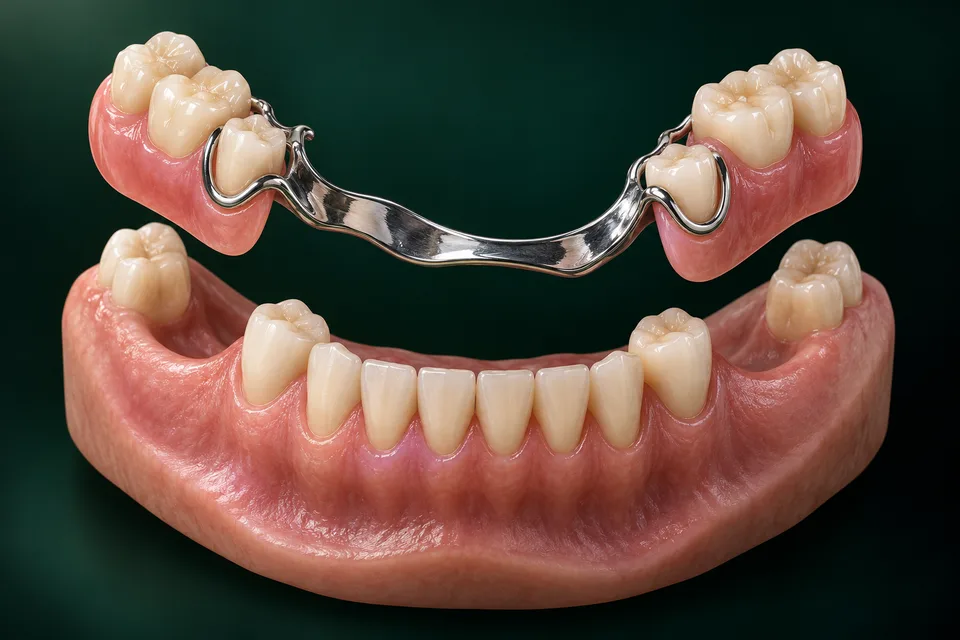
A partial denture fills the gaps and is held by clasps and rests on the teeth that remain.
Select a part
Partial denture
Teeth that fill the spaces.
Only the missing teeth are replaced. The remaining natural teeth stay and help hold the partial in place.
Partial denture
The saddle over the gap.
A pink acrylic base, often on a thin metal framework, carries the replacement teeth over the gum of the missing area.
Partial denture
A natural tooth that anchors the partial.
Its health decides the design. Teeth that carry clasps need careful cleaning because a clasp holds plaque against the tooth.
Partial denture
A flexible metal arm that grips the tooth.
The clasp arm rests below the widest part of the tooth and springs over it when the partial is put in and taken out. Clasps can be metal or tooth-coloured.
Partial denture
A small ledge that stops the partial sinking.
A rest sits in a prepared seat on the chewing surface so chewing force goes down the tooth rather than into the gum.
Partial denture
The gum where the teeth were lost.
The base shares the load with the gum here. Soreness under the base is common at first and is adjusted, never ignored.
An implant-retained overdenture snaps onto attachments on implants, while still resting on the gum. Lift it to see the housing separate from the stud.
Select a part
Implant-retained denture
The same teeth as a conventional denture.
What changes is underneath: the base clicks onto attachments instead of relying on suction alone.
Implant-retained denture
A small cap inside the base.
A metal housing with a replaceable nylon insert is set into the fit surface. The insert wears and is swapped at reviews; its colour sets how firmly it grips.
Implant-retained denture
The stud the denture snaps onto.
A small abutment screwed into the implant projects just above the gum. The denture still rests on the gum; the attachments add retention and stability.
Implant-retained denture
A titanium root in the jawbone.
Two or more implants are placed and allowed to heal before the denture is connected. See the Implant Explorer for how an implant integrates with bone.
Implant-retained denture
Still shares the load.
An implant-retained overdenture is removable and rests on the gum between the implants. A fixed full-arch restoration is a different design.
An educational example of a removable lower overdenture on two attachments. Legacy’s team must confirm the specific designs available and whether one may suit you; fixed full-arch restorations are a different design.
Lifted away from the ridge: the surfaces that need cleaning every day, for the denture and for the mouth beneath it.
Show the design
Ask the team for a cleaning demonstration for your own design. Do not reshape, bend or repair a denture yourself.
Illustrations are conceptual and not to scale. They do not show your anatomy, a particular denture or implant system, or a treatment plan, and they are pending clinical review. An examination is needed to discuss suitability, risks, costs and alternatives.
Legacy’s current website describes full and partial dentures and implant-supported overdentures. The implant design shown here is educational: our team must confirm the specific restoration offered and whether it is appropriate for you. The model shows a removable lower overdenture, not a fixed full-arch restoration.
Understand the differences
Each option has different features. Explore the key differences.
| Feature | Full dentures | Partial dentures | Implant-supported |
|---|---|---|---|
| Typical purpose | Replace an entire arch of teeth. | Replace selected missing teeth. | Replace missing teeth using implant support or retention. |
| What supports it? | Oral tissues over the supporting ridge. | Suitable remaining teeth and oral tissues. | Implants and/or oral tissues, depending on design. |
| Removable? | Generally yes. | Generally yes. | Depends on the restoration. |
| Maintenance focus | Clean the prosthesis and oral tissues. | Clean the prosthesis and remaining teeth. | Clean the prosthesis, attachments and supporting structures. |
A complete denture replaces an arch. A partial fills selected spaces around remaining teeth. Implant-based designs vary; your dental team can explain the available options after an examination.
The highlighted areas show the general supporting structures. A removable implant-retained overdenture may still share support with oral tissues. A fixed implant restoration is a different design.
Removable dentures are designed to be taken out for care. A fixed implant restoration is not removed by the patient. Confirm the specific design and its availability with the team.
Cleaning access differs by design. Ask the team to demonstrate care for your own prosthesis and any remaining teeth or attachments. Professional review remains part of ongoing care.
Educational schematic, not a treatment recommendation. Implant designs and availability require confirmation with the team. Illustrations await clinical review.
From questions to everyday care
A considered process, shaped around your needs.
01 / 05
Start with your goals, questions and oral health. Discuss which tooth-replacement options may be appropriate and what the next steps could involve.
What would you most like to understand about replacing your missing teeth?
02 / 05
Your plan may include impressions, scans or other measurements. The approach depends on your mouth and the restoration being considered.
Ask which records are needed and how the team will assess your fit.
03 / 05
Tooth arrangement, shade and the denture base are considered together. Discuss appearance and any planned opportunities to review the design before completion.
Bring questions about tooth shape, shade and the appearance you prefer.
04 / 05
The team checks the prosthesis in your mouth and reviews how it fits and functions. Follow-up adjustments may be needed as you adapt.
Let the team know about rubbing, soreness or trouble using your dentures.
05 / 05
Leave with a care plan for your own restoration, including cleaning and follow-up. Keep asking questions as you become familiar with your dentures.
Ask who to contact if your fit changes or you need help with care.
Your plan may differ. This overview does not set appointment counts or treatment timelines.
Everyday confidence
Practical guidance for the little things that matter.
Eating
New dentures can change how chewing feels. Start with manageable, softer foods and small pieces, and ask your team how to progress. Sticky or very hard foods can be challenging.
A useful question: “Which foods should I start with for my denture design?”
Speaking
Some words may feel different at first. Reading aloud and repeating unfamiliar sounds can help you practice. Tell the team if speech remains difficult or your denture moves as you speak.
A useful question: “Could an adjustment help the difficulty I’m noticing?”
Cleaning
Clean removable dentures daily with a soft brush and a suitable nonabrasive cleanser. Clean your mouth and remaining teeth too. Follow your dentist’s advice for storage and removal overnight; products and routines vary by material.
Ask for a demonstration. Never use hot water, which can distort a denture.
Fit & adjustments
Oral tissues and supporting structures change over time. New looseness, rubbing, persistent soreness or damage should be assessed. The team can determine whether adjustment, relining or replacement is appropriate.
Do not reshape or repair dentures yourself. Ask for professional help.
Real people. Thoughtful care.
Our team will take time to understand your goals, answer your questions, and help you explore the right options for your needs.
Request a consultationMeet Dr. Penfield ↗A place to begin
Choose what you’d like to understand. No personal information is requested.
Explore how a removable complete denture relates to the tissues of an upper or lower arch. An examination helps establish which options are appropriate.
Explore the denture studioPartial dentures, bridges and implants work differently. The remaining teeth, supporting tissues and your goals are part of that discussion.
Explore crowns & bridgesBring your dentures and questions to a visit. Changes in fit, comfort or function can help guide an examination; this guide cannot identify the cause.
Read about life with denturesRemovable implant-retained overdentures and fixed implant restorations have different support and cleaning needs. The team must confirm the available design and your suitability.
Explore dental implantsCompare purpose, support, removal and maintenance. No single option is right for everyone; use the information to prepare questions for your consultation.
Compare denture optionsEducational guidance, not a suitability assessment. Choices stay on this page and are not submitted or saved.
Helpful answers
There is no guaranteed lifespan. Wear, damage and changes in your mouth can affect fit and function. Regular examinations help determine when adjustment, relining or replacement may be needed.
Tooth shade, shape and arrangement can be considered alongside your preferences. Discuss your goals with the team; appearance depends on the individual design and clinical circumstances.
An adjustment period is common. Eating and speaking may feel different, and follow-up visits can help address fit concerns. Contact the team about persistent irritation or difficulty.
Some designs use dental implants for support or retention. Removable overdentures and fixed restorations are different approaches. Legacy’s team must confirm which specific implant designs are available and whether they may suit your needs.
Ask for a cleaning demonstration for your specific design. Removable dentures generally need daily brushing with a soft brush and an appropriate nonabrasive cleanser, along with care for your mouth and any remaining teeth. Follow the prescribed storage routine.
Adaptation and denture design affect what feels manageable. Softer foods in small pieces can help at first. Very hard or sticky foods may be difficult. Ask for guidance suited to your restoration.
Depending on which teeth are missing and your oral health, alternatives may include bridges or implant-based restorations. An examination is needed to discuss suitable options, their limitations and maintenance.
Cost depends on the design, materials, treatment involved and follow-up needs. Request a personalized treatment estimate and ask our team about insurance and payment options before deciding.
In some cases, professional adjustment or relining can help. Worn or damaged dentures may need replacement. Do not attempt to reshape, bend or repair them yourself; have the fit and condition assessed.
A removable overdenture is designed to be taken out by the patient. A fixed implant restoration stays in place and is removed by a dental professional when needed. Cleaning access and maintenance differ. The team can confirm which designs are available.
Planning your care · Payment options
The type of denture, any implants, and your treatment plan determine the final fee. Ask our team for a treatment estimate and about insurance, direct payment, or Cherry financing.
Financing is subject to eligibility and current terms. No application or payment information is collected on this website.
Let’s talk about your smile
Call us or request a visit — we’re here to help you explore your options for missing teeth.